In the decentralized finance landscape, Ethena Labs has emerged as a groundbreaking solution addressing critical challenges facing stablecoins in the cryptocurrency market. With its innovative delta-hedging approach and the USDe synthetic dollar, Ethena is redefining how stablecoins operate independently from traditional banking systems. But what makes this project unique, and why does ENA token carry a 45.76% APR on iFlux Global’s Token Installment platform? Let’s explore this comprehensive analysis.
What is Ethena (ENA)?
Ethena (ENA) is a decentralized stablecoin issuance protocol built on Ethereum. The project provides a stablecoin solution that doesn’t depend on traditional banking systems, along with a USD savings instrument called the “Internet Bond.” Ethena’s stablecoin (USDe) is a solution developed based on delta-hedging strategy. USDe is fully collateralized transparently on-chain and can be freely used across DeFi applications.
The Internet Bond is built on USDe, combining returns from LST (Liquid Staking Tokens) as well as futures and perpetual swap markets to create the first on-chain bond that can function as a USD savings instrument for users worldwide.
Understanding Delta-Hedging Strategy
Delta-Hedging, also known as Delta Neutral Trading Strategy (Portfolio Balancing Trading Strategy), is used to generate income when the market has no trend. While that’s the definition, in reality there are many methods to apply, and the common goal of these methods is to eliminate price volatility and earn profits.
This means that the user’s position will remain unchanged when the market fluctuates. When applied to the cryptocurrency market, the most commonly used investment method is making the user’s total investment portfolio equal to zero, creating insurance and earning profits from other methods such as: IDO, Airdrop, Staking, Farming, etc.
What Problems Does Ethena Solve?
Stablecoins Are Highly Vulnerable to Traditional Financial Institutions
We can see that popular stable assets in the crypto market are very vulnerable when financial institutions encounter problems. The case of USDC is a typical example, when the parent company of USDC kept $3.3 billion in Silicon Valley Bank. When Silicon Valley Bank had problems, this stablecoin immediately depegged.
Eight Billion People Don’t Have Access to USD Savings Instruments
While US citizens have access to the $30 trillion government bond market, individuals in the rest of the world do not have access to this market.
Ethena’s Solution
Ethena introduces USDe as a solution to address the above problems. This stablecoin is developed with:
Scalability achieved by using derivatives without over-collateralization, as LSTs used as collateral can be hedged with equivalent short positions.
Stability achieved through non-leveraged short positions executed on LSTs immediately when USDe is issued to ensure positions remain neutral.
Censorship resistance by separating collateral from the banking system and storing collateral on decentralized platforms that can be easily verified on-chain.
Key Highlights of USDe
On-Chain Security of USDe
Ethena distributes collateral to a diverse set of MPC custody contracts on-chain. Depositing collateral on-chain ensures independence from centralized servers, thereby minimizing counterparty risk.
Ability to seamlessly connect with major liquidity venues for fundamental risk management and capital optimization while users maintain full oversight of USDe.
Unlocking Leverage
USDe generates fixed returns for users through staking rewards from LSTs and funding rates from short positions.
Ethena will continue to allow minting of USDe based on LSTs to maintain long-term exposure to Ethereum while still creating liquidity for USDe.
No Liquidation Risk
USDe is issued based on a delta-neutral mechanism instead of a debt position (CDP) mechanism like other algorithmic stablecoins, so USDe holders will not face liquidation risk.
How Ethena Works
USDe Issuance Mechanism
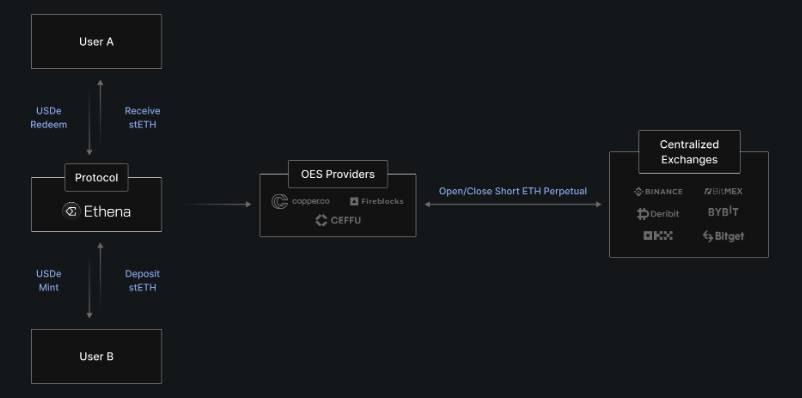
Users deposit various LSTs (stETH, rETH) into Ethena to receive USDe. Slippage and execution fees will be calculated into users’ USDe mint or redeem transactions.
After receiving LST from users, Ethena will open a non-leveraged short order on derivative exchanges with a value equivalent to the assets users deposited into the protocol.
Why Does Ethena Open Short Positions?
As we know, LSTs (stETH, rETH, WBETH) are used as collateral to mint USDe. However, LSTs are altcoins with high volatility, so Ethena needs to open short positions to hedge against price volatility for these assets.
If the market value of LSTs drops sharply, profits from non-leveraged short positions will compensate for the price decline of these LSTs, ensuring their value remains unchanged.
sUSDe: The Staking Mechanism
After receiving USDe, users can stake this stablecoin to receive sUSDe. The profit for users holding sUSDe will come from 2 sources:
- Staking rewards from LSTs
- Funding rates from short positions
The reward mechanism for sUSDe holders will not require users to perform any operations because sUSDe is a value-accumulating token. The value of sUSDe relative to USDe will gradually increase over time.
Understanding ENA Token: Technical Specifications
Token Key Metrics
- Token Name: Ethena
- Ticker: ENA
- Blockchain: Ethereum
- Token Standard: ERC-20
- Token Type: Governance
- Total Supply: 15,000,000,000 ENA
Token Distribution Breakdown
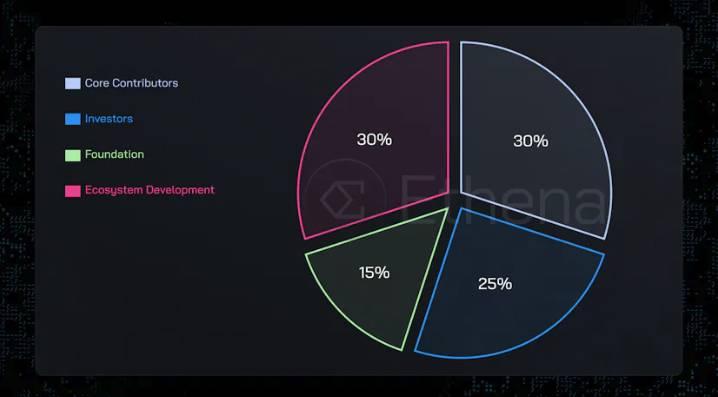
The ENA token distribution is structured as follows:
- Core Team Members: 30%
- Investors: 25%
- Foundation: 15%
- Ecosystem Development: 30%
Token Release Schedule
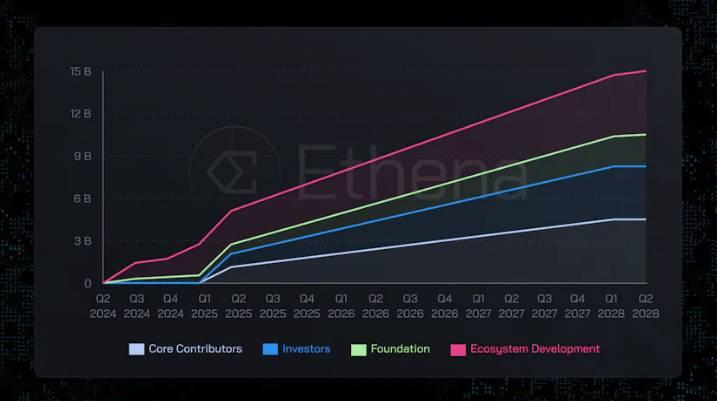
ENA tokens follow a vesting schedule designed to ensure long-term project sustainability and prevent immediate selling pressure from early stakeholders.
ENA Token Utility
The ENA token serves a critical function within the Ethena ecosystem:
Governance: Vote on project governance proposals to shape the future direction of the protocol.
This governance-focused utility ensures that token holders have direct influence over protocol decisions, upgrades, and strategic directions.
Why the 45.76% APR? Understanding Token Installment Interest Rates
When you see a 45.76% APR for ENA on iFlux Global‘s Token Installment platform, you might wonder why the rate is at this level. Let’s break down the factors:
Innovation Risk Factor
Ethena represents an innovative approach to stablecoins through delta-hedging, which is relatively new in the DeFi space. While the protocol has shown impressive traction, it’s still proving its model in various market conditions. The 45.76% APR reflects this innovation premium.
Market Position
Unlike established governance tokens that have years of track record, ENA launched as Binance’s 50th Launchpool project in April 2024, making it a relatively newer token. The 45.76% APR accounts for:
- Newer market presence
- Evolving ecosystem adoption
- Growing but still-maturing user base
- Price discovery phase
Comparison with Other Tokens
The 45.76% APR for ENA sits between established tokens like Bitcoin (4.67% APR) and newer, more volatile tokens like MOVE (65.23% APR). This positioning reflects ENA’s middle-ground status – it has strong institutional backing and proven technology, but is still in growth phase.
Ethena’s Market Performance
Currently, the market has approximately 1.398 billion USDe issued by the Ethena protocol. This stablecoin is trading with a volume of over $100.5 million daily.
For users staking USDe, the APY that Ethena protocol provides reaches up to 35.4%, making it one of the most attractive stablecoin yield opportunities in DeFi.
The number of Shards issued by Ethena protocol has reached 311.4 billion along with over 103,100 users, demonstrating significant early adoption and community engagement.
How to Participate in Ethena Ecosystem
Buying USDe
Users can purchase USDe using 6 types of stablecoins (USDT, USDC, DAI, FRAX, crvUSD, mkUSD) through the Ethena platform. This provides flexible entry points for users from different stablecoin ecosystems.
Staking USDe for sUSDe
After acquiring USDe, users can stake the stablecoin to receive sUSDe, which accumulates value over time through:
- LST staking rewards
- Funding rate earnings from protocol’s hedging positions
Airdrop Criteria
Ethena may airdrop to users based on Shards. The number of Shards is calculated based on various criteria including:
- Amount of USDe held
- Duration of holding
- Staking participation
- Referral activities
Team and Investors
Investment Backing
Ethena has completed multiple funding rounds with strong institutional support:
July 2023 – Seed Round: $6.5 million
- Dragonfly Capital
- Deribit
- OKX Ventures
- Gemini
- Bitmex
- Huobi
- Delphi Digital
- GSR
February 2024 – Binance Labs Investment: Amount undisclosed
February 2024 – Strategic Round: $14 million
- Dragonfly Capital
- PayPal
- Franklin Templeton
- Fidelity
- Binance Labs
- Gemini
The involvement of major traditional finance players like PayPal, Franklin Templeton, and Fidelity signals strong institutional confidence in Ethena’s approach.
Where to Trade ENA
Ethena was the 50th project launched through Binance Launchpool platform.
Users could stake BNB or FDUSD to farm ENA tokens for 3 days from March 30, 2024, to April 2, 2024. Subsequently, the token was listed on Binance exchange at 3:00 PM on April 2, 2024.
Currently, ENA is available on major centralized exchanges following its successful Launchpool event.
How to Profit Using iFlux Global’s Token Installment
Understanding the 45.76% APR and Ethena’s fundamentals, here’s how investors can strategically use iFlux Global’s Token Installment feature:
Capital Efficiency Strategy
Instead of paying 100% upfront for ENA tokens, you can:
- Pay just 15% upfront to gain exposure to ENA’s governance rights and potential upside
- Spread remaining payments over 10 days to 12 months
- Free up capital to participate in Ethena’s ecosystem (buying USDe, staking for sUSDe)
Example Calculation: If you want to acquire $10,000 worth of ENA:
- Traditional purchase: $10,000 upfront
- iFlux Installment: $1,500 upfront (15%), with remaining balance paid over your chosen term
Managing the 45.76% APR
While 45.76% APR is significant, consider these strategic factors:
Interest Payment Structure
For a 6-month installment on ENA purchased with USDT (19.68% APR for USDT payments):
- Borrowed amount: $8,500 (85% of $10,000)
- Interest over 6 months: $8,500 × 19.68% × 0.5 = $836.40
- Monthly cost: approximately $139.40
Ecosystem Yield Offset Strategy
Here’s where Ethena’s ecosystem creates unique opportunities:
- Use unlocked ENA tokens to participate in governance
- Purchase USDe with partial profits
- Stake USDe for sUSDe earning 35.4% APY
- The sUSDe yields can help offset installment interest costs
Risk Management Through Zero Liquidation
Unlike leveraged trading where price drops can force liquidation, iFlux Global’s Token Installment offers zero liquidation risk. This is particularly valuable for governance tokens like ENA because:
- You won’t lose your position during market corrections
- You can maintain long-term governance participation
- Your ENA tokens gradually unlock as you make payments
Token Unlock Schedule Advantage
Remember that ENA tokens unlock gradually after each installment payment:
- After upfront payment: 4.25% of your ENA (unlocked after 12 hours)
- After payment 1: Additional 4.25%
- After payments 2-9: Additional 8.5% each
- After final payment: Remaining 23.5% (including your initial upfront portion)
This structure allows you to:
- Participate in protocol governance with unlocked tokens
- Swap portions to stablecoins (including USDe!) during price surges
- Build position in Ethena ecosystem gradually
Investment Considerations
Opportunities
Strong Protocol Fundamentals
- Innovative delta-hedging mechanism solving real stablecoin problems
- 1.398 billion USDe issued demonstrating product-market fit
- 35.4% APY on sUSDe creating strong value proposition
- Over 103,100 users showing early adoption success
Institutional Validation
- Backed by major crypto-native funds (Dragonfly, Deribit, OKX Ventures)
- Traditional finance involvement (PayPal, Franklin Templeton, Fidelity)
- Binance Launchpool selection (50th project)
- Strong diversification across investor types
Ecosystem Growth Potential
- Addressing $3.3 trillion stablecoin market opportunity
- Providing access to USD savings for 8 billion people globally
- Independence from traditional banking vulnerabilities
- Growing DeFi integration possibilities
Risks to Consider
Protocol-Specific Risks
- Delta-hedging strategy relies on perpetual futures market functioning
- Funding rate volatility could impact sUSDe yields
- Smart contract risks inherent in DeFi protocols
- Regulatory uncertainty around synthetic stablecoins
Market Risks
- ENA price volatility as governance token
- Competition from established stablecoin protocols
- Market conditions affecting APY sustainability
- 45.76% APR reflects elevated risk compared to established tokens
Adoption Challenges
- User education needed for delta-hedging concept
- Competition from simpler stablecoin designs
- Dependency on LST ecosystem health
Smart Trading Strategy with iFlux Global
For investors interested in ENA, here’s a strategic approach using iFlux Global’s features:
1. Layered Ecosystem Participation
Build a comprehensive Ethena position:
- Use Token Installment for ENA governance token (15% upfront)
- Purchase USDe with available capital
- Stake USDe for sUSDe to earn 35.4% APY
- Use sUSDe yields to help cover ENA installment payments
2. Governance-Focused Accumulation
Gradually build governance power:
- Start with modest ENA position via installment
- Participate in governance votes with unlocked tokens
- Increase position based on protocol developments
- Set limit orders at key support levels
3. Yield Optimization Strategy
Maximize returns across Ethena ecosystem:
- Allocate capital between ENA and USDe based on market conditions
- Use Daily Earn (12% APR) for idle capital
- Rebalance between ENA exposure and sUSDe yields
- Monitor funding rates that affect sUSDe APY
4. Risk-Adjusted Position Sizing
Balance opportunity with prudent risk management:
- Don’t overallocate to single protocol
- Maintain diversification across governance tokens
- Use Contract Transfer feature if better opportunities emerge
- Plan exit strategy based on governance participation goals
Real-World Example: Combining ENA Installment with Ecosystem Participation
Let’s walk through a complete strategy:
Month 1: Initial Setup
- Open $10,000 ENA installment contract ($1,500 upfront)
- Use $5,000 available capital to buy USDe
- Stake USDe for sUSDe (earning 35.4% APY)
Monthly Returns:
- sUSDe yield: $5,000 × 35.4% ÷ 12 = ~$147.50/month
- ENA installment payment: ~$139.40/month
- Net: $8.10 positive cash flow while building ENA position
Growth Scenario: If ENA appreciates 40% over 6 months:
- Your $10,000 position becomes $14,000
- Profit: $4,000
- Interest paid: $836.40
- Net gain: $3,163.60 (31.6% return on initial $1,500 + payments)
This example shows how the Ethena ecosystem’s high yields can help offset installment costs while building governance positions.
The Broader Implications: Why Ethena Matters
Ethena represents more than just another DeFi protocol – it’s attempting to solve fundamental problems in the stablecoin space:
Breaking Banking Dependencies
The $3.3 billion USDC depeg incident during Silicon Valley Bank’s collapse exposed critical vulnerabilities in bank-dependent stablecoins. Ethena’s approach of maintaining collateral on-chain and using delta-hedging eliminates this single point of failure.
Democratizing USD Access
Eight billion people lack access to USD-denominated savings instruments. The Internet Bond concept provides a globally accessible, censorship-resistant alternative to traditional bond markets, potentially democratizing access to stable yield generation.
Sustainable Yield Generation
Unlike many DeFi protocols offering unsustainable yields, Ethena’s returns come from:
- Real staking rewards from Ethereum LSTs
- Funding rates from perpetual markets
- Both are market-driven, sustainable sources
The current 35.4% APY on sUSDe, while attractive, is backed by actual economic activity rather than token emissions.
Comparing ENA’s 45.76% APR to Market Context
To put the 45.76% APR in perspective:
Lower APR Examples:
- Bitcoin (BTC): 4.67% APR – established, low volatility
- Major DeFi blue-chips: 8-15% APR typically
Similar APR Range:
- ENA: 45.76% APR – innovative protocol, strong backing, proven product
- Mid-cap governance tokens: 35-55% APR range
Higher APR Examples:
- New Layer 1/Layer 2 tokens: 60-80% APR
- MOVE: 65.23% APR – newer mainnet, higher volatility
ENA’s positioning reflects its status as an established protocol (1.398B USDe, 103K users) with innovative but proven technology, backed by top-tier investors, but still in growth phase.
Conclusion: Is ENA Worth the 45.76% APR?
Ethena represents a sophisticated solution to real problems in the stablecoin market, backed by strong institutional investors and demonstrating genuine product-market fit with 1.398 billion USDe issued and over 103,100 users. The 45.76% APR on iFlux Global’s Token Installment platform reflects ENA’s position as a governance token for an innovative but maturing protocol.
For the right investor, this could be an opportunity:
- If you believe in Ethena’s delta-hedging approach to stablecoin issuance
- If you want exposure to the growing stablecoin market without traditional banking dependencies
- If you value the 35.4% APY ecosystem yields that can help offset installment costs
- If you want capital-efficient governance participation in a promising DeFi protocol
The key is understanding that the 45.76% APR isn’t just a cost – it’s a reflection of ENA’s risk-reward profile as an innovative protocol solving real problems. By using iFlux Global’s Token Installment with features like zero liquidation risk, flexible payment terms, and gradual token unlocking, you can strategically position yourself in Ethena’s ecosystem while managing capital efficiently.
Moreover, the unique opportunity to earn 35.4% APY through sUSDe while building your ENA position creates a compelling value proposition that can partially offset installment costs – something not available with most other tokens.
As always, conduct your own research, only invest what you can afford to lose, and consider your personal risk tolerance before making investment decisions.