As we navigate the digital age, the quest for seamless content sharing has never been more critical. Then entered TRON, a bold initiative led by the enigmatic Justin Sun, aiming to liberate digital creators from traditional gatekeepers. But what sets TRON apart in a crowded market? Don’t skip this article as we unveil everything you need to answer the question “What is TRON?” and how crucial a role its native token, TRX, plays.
What is TRON?
Founded in July 2017 by the non-profit TRON Foundation, TRON is led by CEO Justin Sun, who is known for his visionary approach to digital content and blockchain technology. The foundation comprises a talented team of tech experts and blockchain enthusiasts, including notable figures like Lucien Chen and Maorong Lin.
TRX initially debuted as an ERC-20 token on the Ethereum blockchain during its initial coin offering in August 2017. In 2018, TRON launched its mainnet, prompting the migration of TRX tokens to this new blockchain.
At its core, TRON is a decentralized blockchain platform that facilitates the creation and sharing of digital content. By eliminating intermediaries, it enables users to publish, own, and store data freely, allowing artists and authors to distribute their work directly without traditional platform constraints like Amazon or YouTube.
TRON’s infrastructure boasts impressive scalability, with a processing capacity of up to 2,000 transactions per second (TPS) through its Delegated Proof of Stake (DPoS) consensus mechanism. This design enhances the user experience and encourages platform growth. With its native cryptocurrency, TRX, users can engage in various activities, from transaction fees to participating in platform governance.
How TRON works
Now that you have a basic understanding of what is TRON, let’s explore how it works.
TRON operates on a decentralized architecture that empowers users to control their digital content without intermediaries. At its heart is the Delegated Proof of Stake (DPoS) consensus mechanism. In this system, TRX holders can vote to elect super representatives who validate transactions and secure the network. These representatives play a crucial role in maintaining blockchain efficiency while enabling rapid transaction processing.
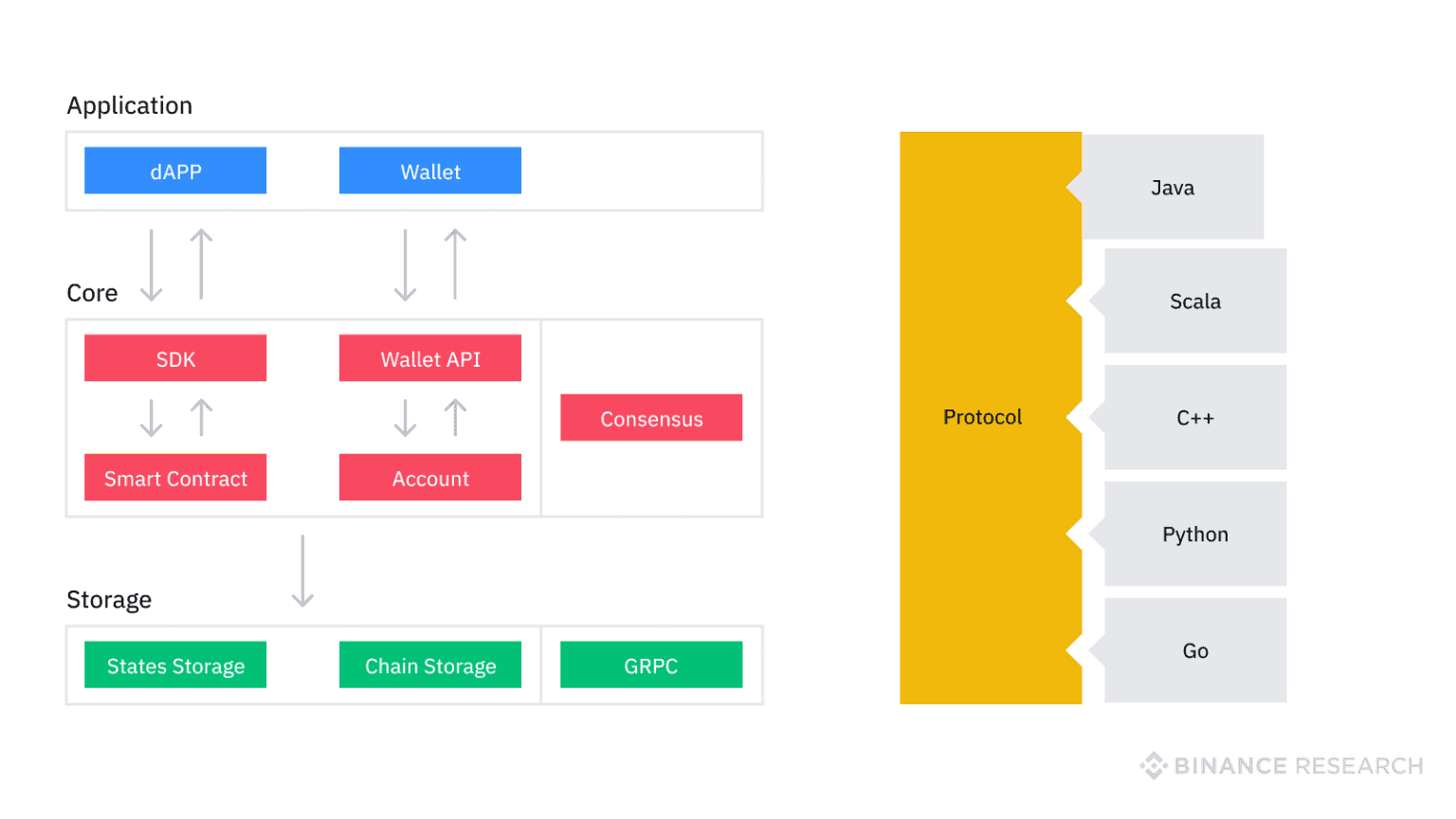
TRON’s architecture is structured into three main layers, each serving a distinct purpose to enhance its functionality and scalability:
- Core Layer: This foundational layer of TRON includes key components like the DPoS consensus mechanism, which enables users to vote for super representatives validating transactions, and supports smart contracts via the TRON Virtual Machine (TVM), compatible with languages like Solidity.
- Storage Layer: Focused on efficient data management, this layer combines Chain Storage using LevelDB to minimize on-chain requirements and State Storage with KhaosDB to efficiently retain the latest blockchain states, ensuring quick access and enhanced performance.
- Application Layer: This is where developers build their DApps. The Application Layer leverages Google’s Protocol Buffers, allowing flexibility in programming languages for DApp development. This layer fosters innovation and a wide range of applications within the TRON ecosystem.
Furthermore, TRON allows users to stake TRX tokens, earning rewards and participating in network governance. By facilitating a direct connection between content creators and consumers, TRON aims to revolutionize how digital content is distributed and monetized.
Core values
TRON is committed to empowering users with ownership of their data while promoting a decentralized internet. The platform emphasizes equitable profit-sharing among contributors and ensures that all contributions are valued equally. By operating as a nonprofit organization, TRON aims to support content creators globally, fostering a vibrant digital ecosystem.
Key advantages
As a decentralized content protocol, TRON offers 4 distinctive features compared to traditional centralized Internet:
- Data liberation: Users have the freedom to download, store, and share various types of content, including text, images, audio, and video without centralized control.
- Permissible content creation: Digital assets can be generated through the distribution of content, stimulating an economic environment that fosters the development of a vibrant content ecosystem.
- Personal ICOs: Individuals can freely distribute digital assets as ICOs, enabling others to benefit from services and innovations driven by ongoing contributions from data collaborators.
- Robust infrastructure: With distributed digital assets, TRON provides a comprehensive infrastructure that supports decentralized exchanges, autonomous games, prediction markets, and gaming systems.
Justin Sun – The infamous founder
Justin Sun, the founder of TRON, is a prominent and controversial figure in the crypto space. He’s even called the next Jack Ma. Born in 1990 in Qingdao, China, Sun gained attention with his previous work at Ripple Labs and the social app Peiwo, which amassed over 10 million users.
In 2017, he launched TRON, raising $70 million through a record-breaking ICO aimed at decentralizing content and entertainment. Under his leadership, TRON became essential for stablecoin transfers, boasting over $60 billion in USDT circulation by mid-2025.

Despite his achievements, including acquiring BitTorrent for $140 million and launching the BTT token, Sun’s journey is marred by controversies. He faced accusations of plagiarism and was sued by the SEC in 2023 for unregistered securities sales. His activities, including claims for COVID relief funds and involvement in alleged wash trading, have sparked significant debate about his influence and intentions in the crypto market.
TRON’s core team: More than just Sun
Beyond Justin Sun, TRON’s success is supported by a dedicated team. Key figures include Ben Chow, who oversees liquidity pools, and Rory Gu, the CTO responsible for improving transaction speeds and integrating stablecoins. Working under the structure of the TRON DAO, this compact team focuses on scalability and community governance, ensuring continual growth and innovation in the TRON ecosystem.
TRON protocol roadmap 2025
The TRON team has outlined a comprehensive roadmap for 2025, aiming to enhance stability, scalability, and economic efficiency.
- Stability enhancements
TRON will upgrade its P2P network layer in Q3 2025 to address issues like malicious connection flooding and isolated nodes, ensuring robust network performance even during high transaction volumes.
- Scalability and performance improvements
In Q2 2025, TRON will support ARM architecture, enabling deployment on cost-effective devices. The API will be optimized for faster responses and greater stability. Plans for parallel transaction execution and fast finality using a dual consensus mechanism will significantly increase transaction throughput and reduce finality time to about six seconds.
- Economic Model Optimization
TRON will adjust transaction fees dynamically, making on-chain transactions more cost-effective and sustainable. By refining fee structures, the protocol ensures fair costs for both smart and non-smart contract transactions.
- Others
- First, an Incremental Consensus Mechanism will enhance computational performance by calculating incremental state roots from block changes.
- Second, to support decentralization, a state expiry solution will manage growing chaindata by using state leasing and cold storage.
- Lastly, account abstraction will upgrade EOA wallets to smart contract wallets, improving user flexibility and dApp integration on the network.
What is TRX?
TRX, or Tronix, is the official cryptocurrency of the TRON blockchain. Initially launched as an ERC-20 token on Ethereum, it transitioned to its own mainnet on May 31, 2018, allowing for enhanced capabilities and independence within the TRON ecosystem. At the time of writing, TRX is currently ranked 8th in market cap, according to CoinMarketCap.
Key metrics
- Ticker: TRX
- Blockchain: TRON
- Consensus Mechanism: Delegated Proof of Stake (DPoS)
- Total supply: 94,671,924,210.12 TRX (updated on 17th Nov, 2025)
- Circulating supply: 94,671,932,402.38 TRX (updated on 17th Nov, 2025)
- Block time: 3 seconds
- Transaction speed: 2000 transactions per second (TPS)
- Block Reward: 32 TRX
- Token Standard: TRC10, TRC20
Tokenomics
The initial allocation of the TRON (TRX) token, which had an initial total supply of 100 billion tokens at its launch in 2017, was distributed as follows:
- Public Sale (ICO): 40.25%
- TRON Foundation & Ecosystem Development: 34%
- Private Sale: 15.75%
- Peiwo App (Initial Supporter/Company owned by Justin Sun): 10%

Use cases of TRX
- Transaction fees: TRX is used for paying transaction and smart contract execution fees within the TRON network. Fees paid in TRX are burned, effectively reducing the total supply over time.
- Rewards: TRX serves as a reward for super representatives, who are elected to validate transactions and maintain the network.
- Governance: TRX holders can participate in voting on important governance decisions, helping shape the future of the TRON ecosystem.
- Payments: The token is also utilized for making purchases of goods and services within applications built on the TRON platform.
Buy TRX
TRX has been listed on numerous exchanges, including iFlux Global. iFlux uniquely offers the option to buy TRX with a starting down payment of just 15%, allowing users to adjust their capital to their advantage.
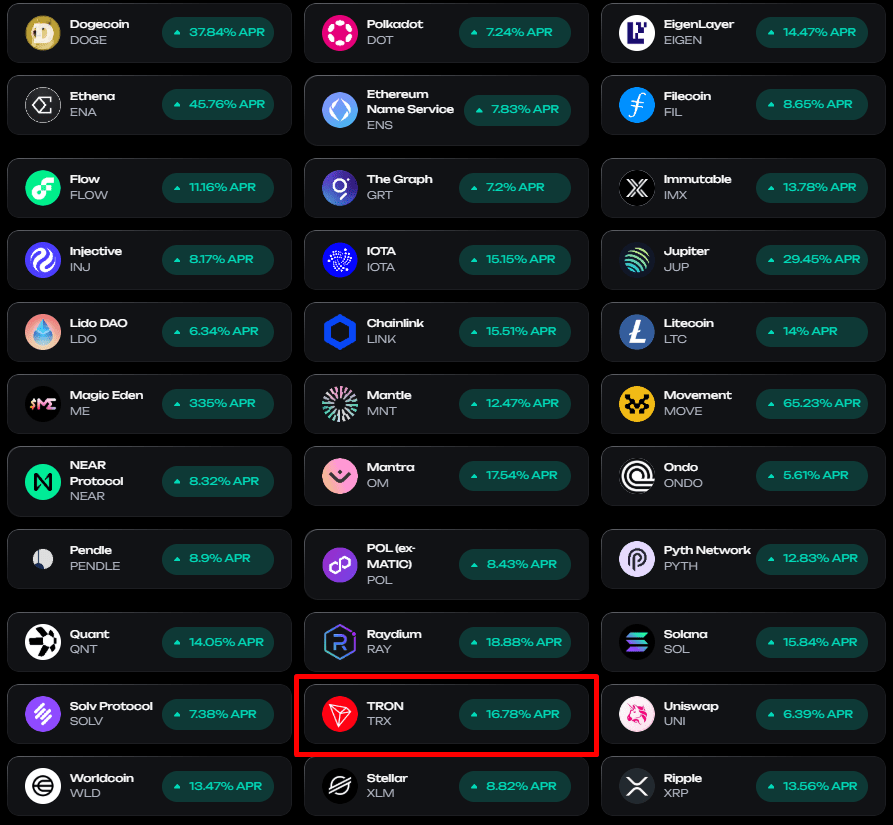
Buying TRX on iFlux Global: Capital efficiency with 16.78% APR
TRX is a token that currently ranks in the top 10 by market cap, offering stability and strong liquidity, making it a popular choice among investors. While acquiring TRX outright can tie up capital, our Token Installment feature lets you gain full exposure with just 15% upfront, spreading the rest over flexible terms (10 days to 12 months).
Capital efficiency in action
Instead of a full $10,000 USDT upfront for TRX, you pay $1,500 USDT (15%) immediately and receive proportional tokens after 12 hours. The remaining $8,500 USDT is divided into 10 equal terms, with a fixed 16.78% APR locked at purchase. For a 6-month term (0.5 years, paid in USDT at 19.68% APR for repayment):
- Borrowed amount: $8,500 USDT
- Total interest: $8,500 × 16.78% × 0.5 = $713.15 USDT
- Total to repay: $8,500 + $713.15 = $9,213.15 USDT
- Per term (~18 days): $9,213.15 ÷ 10 = $92.13 USDT
That is seemingly a better way to acquire TRX with a humble fund. Moreover, you can enjoy a 12% APR with Daily Earn the moment you deposit, allowing your investment to grow while you hold your tokens.
Zero liquidation & gradual unlocking
iFlux’s zero liquidation means your position survives TRON’s occasional volatility—no forced sales during dips. Tokens unlock progressively:
- After upfront: 4.25% available (12 hours)
- After payment 1: +4.25%
- Payments 2–9: +8.5% each
- Final payment: Remaining 23.5% (including initial)
This lets you stake early for yields, participate in DAO votes, or swap during pumps, all while averaging in over time.
Early exit & take profit: Locking in gains without the full commitment
Token Installment offers a flexible approach for investors looking to maximize profit. After making your first payment, you can terminate the contract early and receive your settlement within 12 hours. However, be mindful of a penalty fee ranging from 1.8% to 0.2% of your upfront amount, which applies based on the number of payments made. This structure aims to discourage premature exits while still allowing for net profit if the token appreciates sufficiently.
How it works: Penalty & adjusted tokens formula
Penalty scales with progress:
- 1.8% after Payment 1, down to 0.2% after Payment 9
- Your received tokens = (Upfront % – Penalty %) of total value
- Net profit = (Value of received tokens) – (Upfront payment after penalty deduction)
Example:
Say you buy TRX worth $10,000, paying $1,500 upfront (15%) in USDT. 6-month term, 16.78% APR.
You make 3 payments, then TRX rises 25% to $12,500 total value. Exit now and here’s what you’ll receive:
- Penalty after 3 payments: 1.4% of upfront = $21 deduction
- Adjusted tokens received: 15% – 1.4% = 13.6% of $12,500 = $1,700 worth of TRX
- Net Profit: $1,700 – $1,500 (upfront) – $21 penalty = +$179
Without the pump, you’d eventually break even. However, with a price increase, you can achieve early gains without the risk of liquidation. So in many cases, Token Installment can play as a smart tool for every trader.
For more information, please check: https://iflux-global.gitbook.io/iflux-global/token-installment/contract-liquidation
TRX’s 16.78% APR: A reliable choice on iFlux Global
$TRX stands as a battle-tested powerhouse for stablecoin transfers and high-throughput transactions, with over 290 million user accounts, 9.7 billion total transactions, and $60 billion in USDT circulation.
The 16.78% APR offered on TRX through iFlux Global represents a balanced and attractive option for investors seeking stability in the volatile cryptocurrency market. At 16.78% APR, TRX sits in the mid-range (e.g., between BTC‘s 4.67% and Solana’s 15.84%). This reflects TRX’s mature, low-volatility profile as a utility token in a proven ecosystem (compared to newer names like MOVE), offering a balanced entry compared to riskier newcomers.
As a prominent token within the blockchain ecosystem, TRX provides an opportunity for users to engage in decentralized finance without the excess risk associated with higher-yield options. On iFlux Global, Token Installment’s zero liquidation risk, flexible 10-term payments, and gradual unlocking let you stake early portions of TRX for governance rewards, turning borrowing into a HODL accelerator.
Conclusion
As market dynamics evolve, TRON’s commitment to stability, innovation, and community engagement positions it favorably for future growth. Investors and users alike can look forward to the continued development of TRON, leveraging the power of TRX to explore new opportunities in the ever-expanding digital economy.